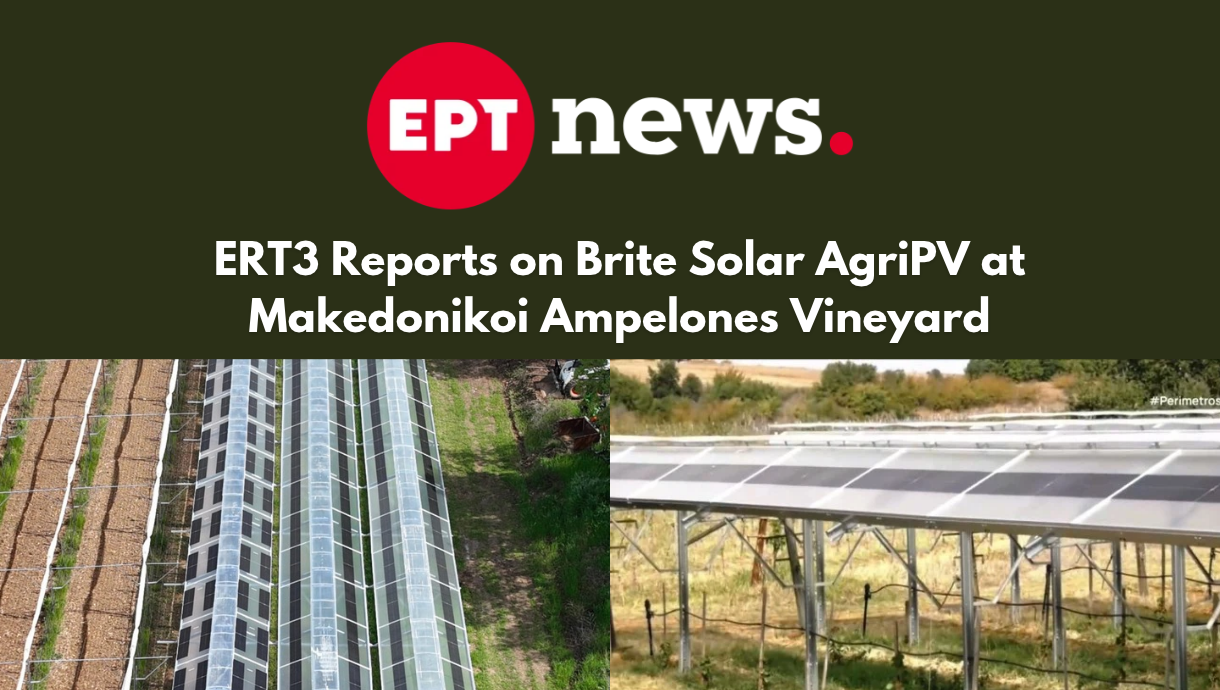
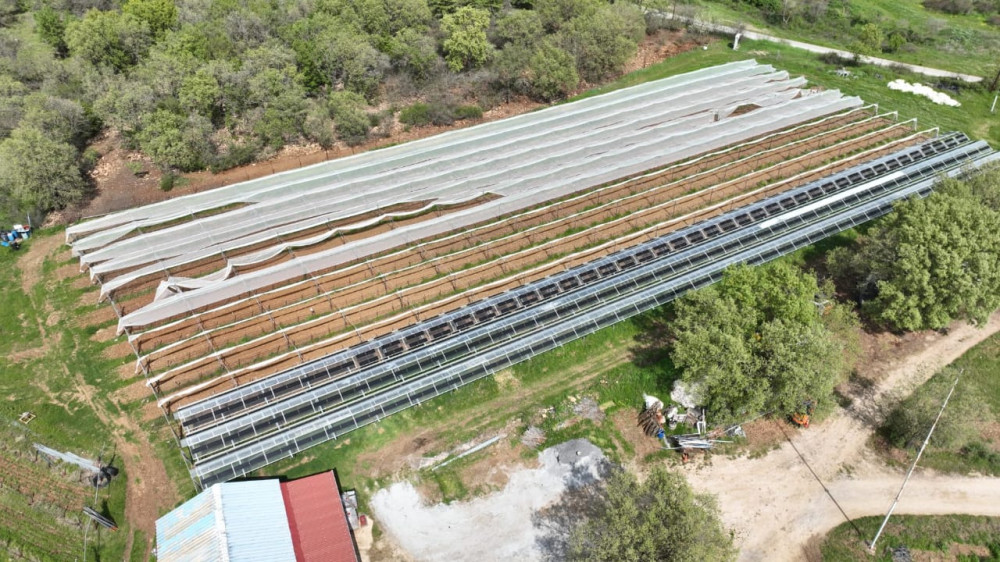
On 9 October 2026, ERT3, the Northern Greece channel of the public broadcaster ERT, dedicated a television report to agrivoltaics. The location: a vineyard in Terpyllos, Kilkis. The installation: Brite Solar agrivoltaic panels above active grapevines at Makedonikoi Ampelones.
Read the full report in Greek here.
Journalist Nikos Pitsiakidis prepared the report, which stands as one of the clearest real-world demonstrations of what agrivoltaics means in practice: not in theory, but in the field, from the person who has lived it.
The Farmer Speaks
Giorgos Papadopoulos, representative of the producer group Makedonikoi Ampelones, welcomed the ERT3 crew at the vineyard where he cultivates the exclusive table grape variety "Pristin", the rights to which belong solely to Makedonikoi Ampelones.
He spoke to the camera with the directness of someone who has seen the results firsthand, not someone who has read about them:
"If this system did not exist, we would have had to invent it ourselves."
For a grower who sees the daily cost of conventional farming, the financial picture is equally clear:
"The conventional structure gives nothing back. You pay workers at every stage of production every year. In two years I will have paid it off."
And on the connection with smart irrigation, one sentence that says more than any technical description:
"It asks for water when it's thirsty."
The Technology Behind the Panels
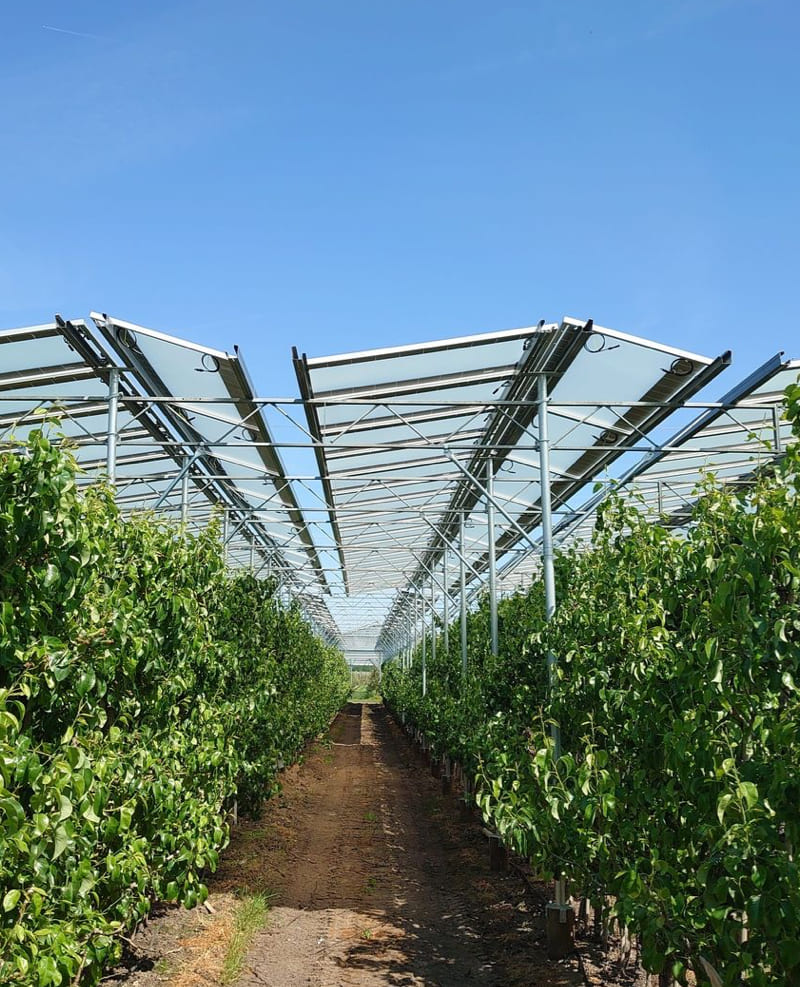
Brite Solar, using its patented nanocoating technology, manufactures semi-transparent agrivoltaic panels that allow the passage of light essential for photosynthesis and plant growth. Thanks to the specialised nanocoatings, part of the ultraviolet radiation is converted into red light, which plants can use during photosynthesis.
At the same time, the structure acts as a protective canopy against extreme weather conditions:
- Hail, heavy rainfall and snowfall
- Strong winds, within the structure’s design specifications
- Excessive solar radiation and high temperatures, reducing heat stress on the plants
The result is the combined use of the same agricultural area for crop production and clean electricity generation. Full technical specifications are available in the Brite Solar datasheets.
Smart Farming in the Field
The system goes beyond energy generation and crop protection. It connects with Smart Farming through field sensors that continuously measure soil moisture, temperature and pH levels, optimising irrigation in real time. As Mr Papadopoulos put it: "It asks for water when it's thirsty." A single sentence that captures the entire philosophy of precision agriculture — nothing is wasted, everything happens at the right moment.
Cost and Payback
The agrivoltaic structure costs approximately five times more than a conventional one. However, as the grower himself points out, the conventional structure gives nothing back beyond its basic function, while the agrivoltaic system pays for itself in just two years.
It is also worth noting the Greek Prime Minister's commitment to 160 MW exclusively for agrivoltaic applications, which guarantees grid access for the energy produced.
The Installation: 20 ha Vineyard in Kilkis
The agrivoltaic installation at Makedonikoi Ampelones in Kilkis covers 200 stremmata of active vineyard with a total installed capacity of 48.1 kWp.
If you are wondering what something similar could mean for your own crop, get in touch with our team. We would be happy to discuss it with you.
Source: ERT3 / ERTnews.gr, 9 October 2026 - Report: Nikos Pitsiakidis | Written by: Evmorfia Dimitrakopoulou
Nerantzaki Kiki
18/10/2026