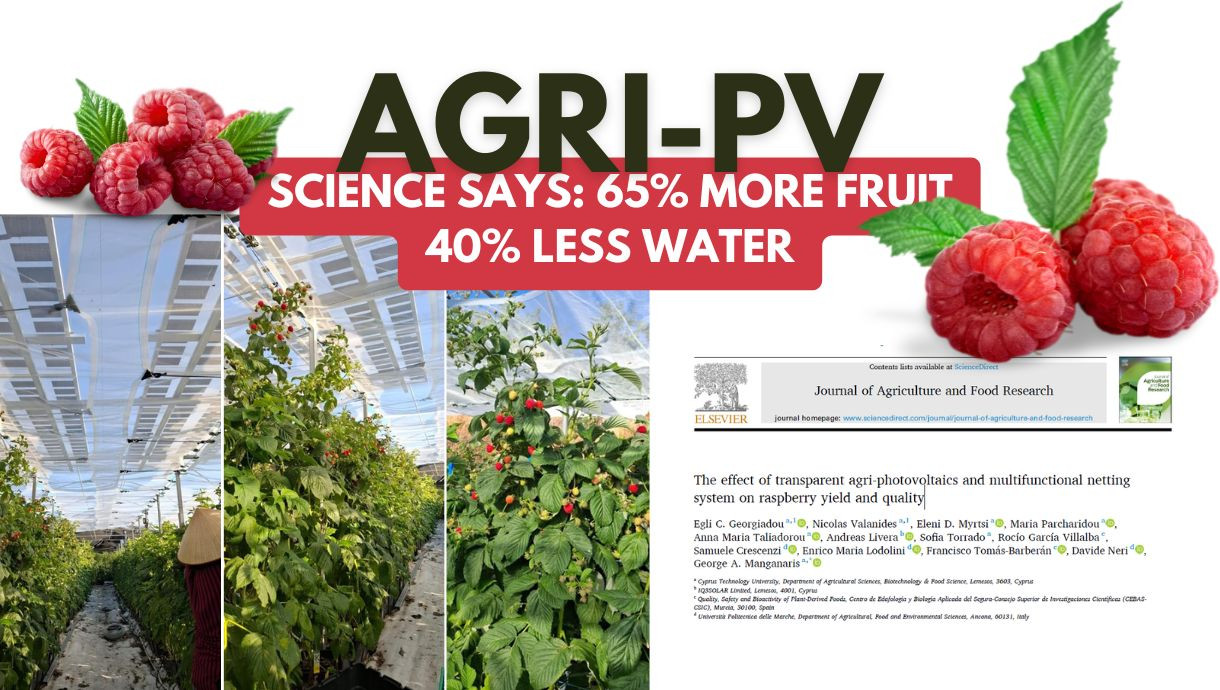
A 65% increase in raspberry yield. A 60% improvement in water use efficiency. Fruit quality fully preserved. These are not marketing claims. They are the findings of a peer-reviewed study published in the Journal of Agriculture and Food Research (Elsevier, 2026), one of the most respected academic journals in agricultural science. And at the centre of the experiment: Brite Solar semi-transparent AgriPV panels.
The Study: Who Conducted It and Why It Matters
The research was led by scientists from Cyprus Technology University, in collaboration with Università Politecnica delle Marche (Italy) and the Centro Superior de Investigaciones Científicas (CSIC) (Spain). Together, they represent three of Europe's agricultural research institutions. The FARMPV project funded this study under the EU NextGenerationEU instrument through the Research and Innovation Foundation of Cyprus.
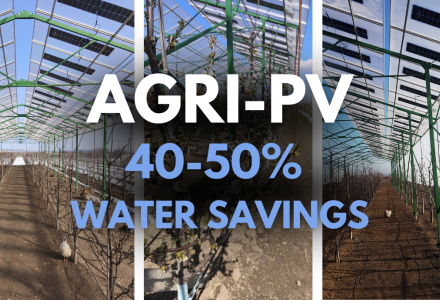
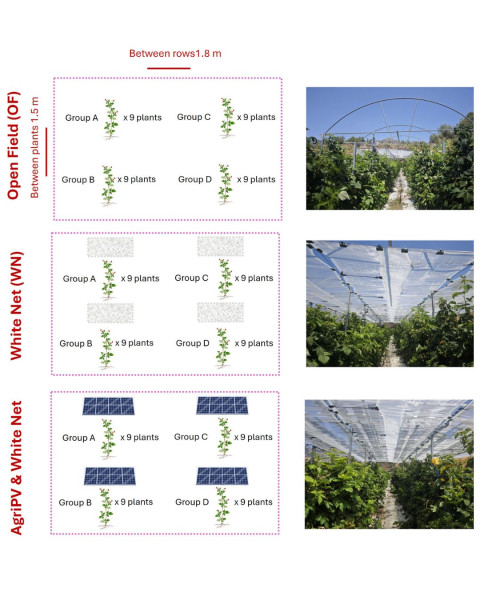
The researchers evaluated three agrivoltaic raspberry production systems side by side at 1,250 metres above sea level in Chandria village, Limassol District, Cyprus, one of the most climatically demanding agricultural environments in Europe. This is not the first time Brite Solar panels have demonstrated measurable benefits in fruit cultivation. Similar results were recorded in a bitter cherry agrivoltaic project, where water savings of 40-50% were also confirmed.
The three cultivation systems tested in the study were:
- AgriPV with white netting Brite Solar BSG-300/54-F panels
- White netting alone
- Open field cultivation with no protection
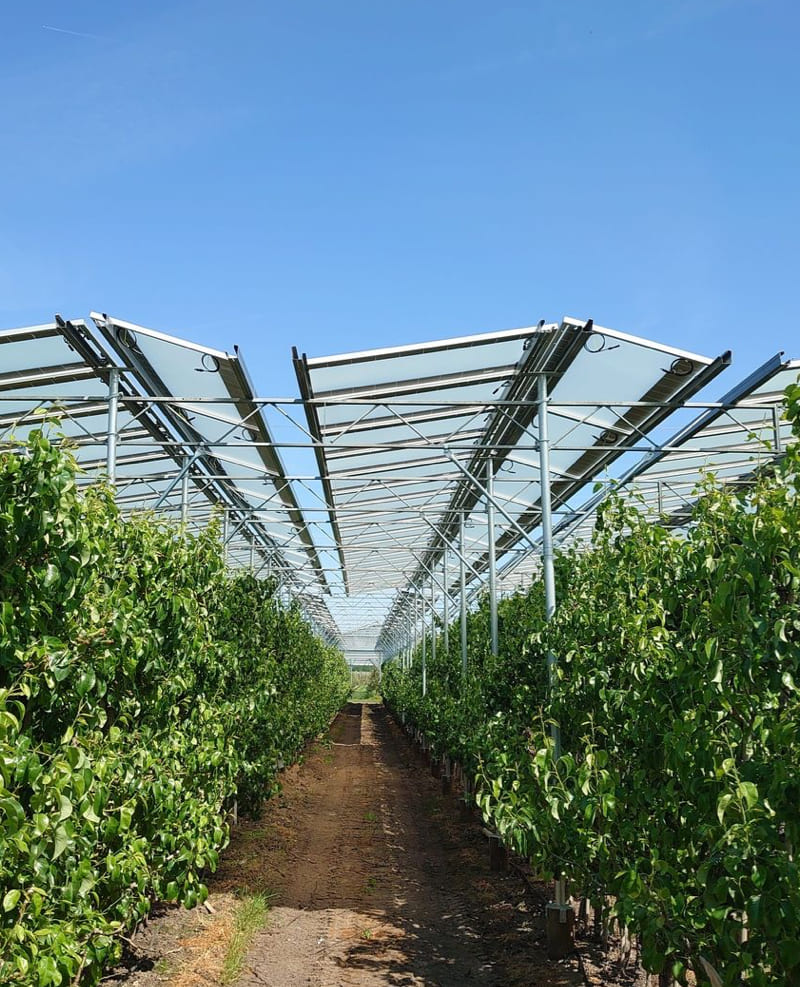
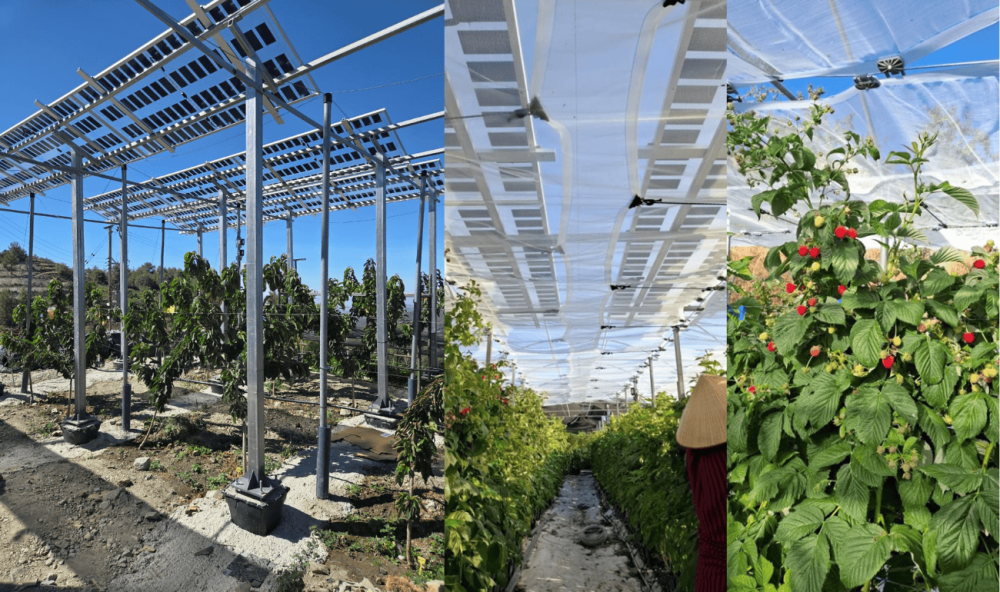
For the AgriPV system, the researchers conducted a thorough review of available technologies and explicitly selected Brite Solar BSG-300/54-F GreenGlass panels, elevated at 3.5 metres above the crop, for their ability to provide precise and reliable modulation of light transparency. Full technical specifications are available in the Brite Solar datasheets.
The Results: Four Findings That Change the Conversation
All results below compare the AgriPV and white netting system combined against open field cultivation, unless stated otherwise.
1. 65% More Raspberries from the Same Land
Over the full primocane season from August to November, raspberries grown under the combined AgriPV and white-net system produced 65% more fruit than those grown in the open field. The effect was most dramatic in August, the hottest month, where production was 89% higher than open field. In September it was 76% higher. In October, 41% higher. Even in the cooler month of November, the system still delivered a 10% advantage.
Open field plants experienced severe physiological stress under peak temperatures, while plants under the panels maintained stable photosynthetic activity. The system reduced canopy temperature and incoming solar radiation, keeping the raspberry plants within the optimal thermal window for photosynthesis.
2. 60% Better Water Use Efficiency
In Mediterranean climates, water is the scarcest resource. The study measured exactly how much water was needed to produce each gram of raspberry fruit:
- Open field: 1.76 litres per gram of fruit
- White net alone: 1.56 litres per gram of fruit
- Brite Solar AgriPV with white netting: 1.07 litres per gram of fruit
That is a 40% reduction in water consumption per gram of fruit produced and a 60% improvement in overall water use efficiency compared to open field cultivation. For growers facing permanent water scarcity and rising irrigation costs, this is a structural transformation in how the orchard operates.
3. Fruit Quality Fully Preserved and Sugar Content Improved
One of the most common concerns about agrivoltaics is that shading reduces fruit quality. This study puts that concern to rest. Analysis confirmed that total soluble sugars were higher under the system at every harvest point compared to open field cultivation. Glucose and fructose content improved at the early harvests, while sucrose content was higher at the second and third harvest points.
The health-promoting compounds that make raspberries a superfood, including cyanidin derivatives, the primary anthocyanins responsible for antioxidant activity, were largely unaffected. Aroma composition was driven primarily by harvest timing rather than cultivation system, indicating the technology did not disrupt the fruit's natural flavour development.
4. A More Resilient Microclimate Under the Panels
The study instrumented both the covered and open field areas with sensors measuring air temperature, soil moisture, humidity, leaf temperature and Vapour Pressure Deficit (VPD). The data showed that the Brite Solar panels created a measurably more favourable microclimate, with lower leaf temperatures, reduced VPD particularly during August temperature extremes.
The AgriPV system also improved photosynthetic efficiency, measured as quantum efficiency of PSII. The plants under the panels photosynthesised more effectively, not less, despite receiving less direct radiation.
Why Brite Solar Panels Were Selected for This Study
The research team conducted a thorough review of available agrivoltaic technologies before making their selection. Brite Solar BSG-300/54-F was chosen specifically for its precise and reliable
modulation of PV transparency, the ability to calibrate exactly how much light
passes through to the crop to optimise growth conditions.
Transparency is not a fixed specification. It is calibrated project by project, matched to the crop variety, local climate, and production goals of each farmer. The Chandria village raspberry installation is a real-world demonstration of what that precision delivers at scale. Learn more at Brite Solar's agrivoltaic technology page.
What This Means for Fruit Growers in Mediterranean Climates
The study site in Cyprus represents one of the harshest agricultural environments in Southern Europe. Summer temperatures regularly exceed 35°C, solar radiation goes above 800 W/m², and annual precipitation stays below 500 mm. If agrivoltaics works here, at 1,250 metres altitude, with this level of heat stress, it works across the Mediterranean.
The conclusions of the research team are unambiguous: dual land use for raspberry production and electricity generation is both technically feasible and agronomically beneficial under Mediterranean conditions. The authors specifically identify raspberries and potentially other soft fruits as strong candidate crops for agrivoltaic integration, particularly in regions experiencing temperature extremes during summer.
For farmers and growers asking whether agrivoltaics is right for their crop, this study provides the strongest possible answer: peer-reviewed, multi-institutional, EU-funded scientific evidence that Brite Solar panels deliver more fruit, less water used, and better plant health, without compromising the quality that premium fruit markets demand.
The Bigger Picture: Science Backing a Sustainable Future
According to FAOSTAT data cited in the study, global raspberry production surpassed 956,000 tonnes in 2023. Climate change is already reducing yields across Mediterranean growing regions. Water scarcity is intensifying. The EU's 600 GW solar target by 2030, cited in the study, requires land that agriculture cannot afford to lose.
Agrivoltaics answers all three pressures simultaneously. This study, published in a leading Elsevier journal, authored by researchers from three European universities and research institutions, and conducted with Brite Solar technology, is the clearest evidence yet that the answer works.
Interested in exploring agrivoltaics for your raspberry farm, berry operation, or orchard? Get in touch with the Brite Solar team for a personalised technical assessment tailored to your crop and climate.
Frequently Asked Questions
Does shading from AgriPV panels reduce raspberry quality?
No. The peer-reviewed study confirmed that total soluble sugars were higher under Brite Solar AgriPV panels at every harvest point. Health-promoting compounds including cyanidin derivatives were unaffected. The technology protects the plant without reducing fruit quality.
How much water can agrivoltaics save in fruit production?
The study measured 1.07 litres of water per gram of raspberry fruit under the AgriPV system, compared to 1.76 litres in open field cultivation. That is a 40% reduction in water consumption per gram of fruit produced and a 60% improvement in overall water use efficiency.
What crops benefit most from agrivoltaic systems?
Heat-sensitive, high-value crops benefit most. The study identifies raspberries and other soft fruits as strong candidates for agrivoltaic integration, particularly in Mediterranean climates with high summer temperatures. Other documented crops include nectarines, bitter cherries, grapes and blueberries.
Source: Georgiadou E.C. et al. (2026). The effect of transparent agri-photovoltaics and multifunctional netting system on raspberry yield and quality. Journal of Agriculture and Food Research, 29, 103128. https://doi.org/10.1016/j.jafr.2026.103128
Nerantzaki Kiki
13/07/2026